Data SIO, NOAA, U.S. Navy, NGA, GEBCOLandsat / CopernicusIBCAOU.S. Geological Survey.
This blog series, titled “Witnessing the Amazon: Stories of Crisis and Possibility”, shares the stories, encounters, insights, and questions that emerged during a six‑week field trip my two doctoral students, Nils Mojem (Germany) and Héctor Pérez Zamora (Venezuela), and I undertook across the Amazon in May and June 2025. While grounded in the day‑to‑day realities of travel and fieldwork, this series is not a travel diary. It is an invitation to accompany us into a territory that holds profound significance for the future of life on Earth, and to explore how stories from specific places – and the cracks running beneath their surface – can illuminate pathways toward transformation.
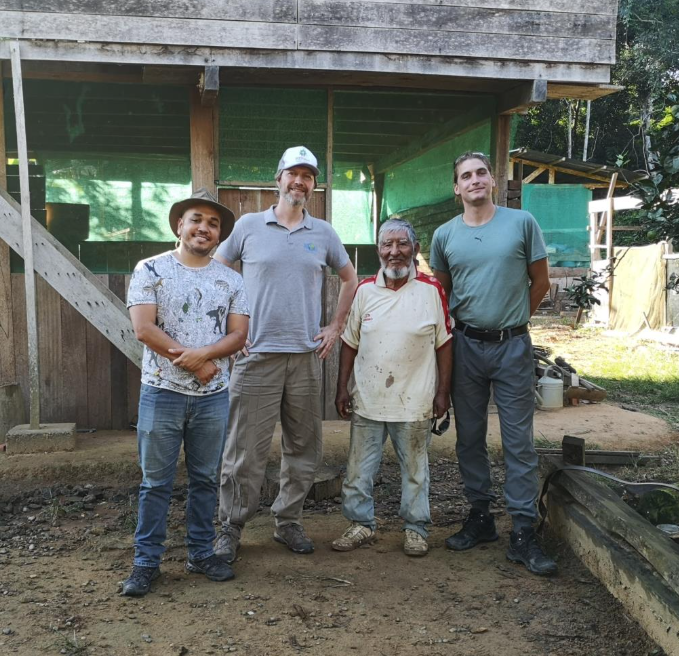
Photo (left to right): Hector Perez, Adrian Beling, Don Gabino Callata Ticona (retired teacher, agroecological farmer and our host in the village of CPM Mavila, Madre de Dios, Peru) and Nils Mojem.
The field trip was part of FIAT (Faith Institutions Advancing Transformation), a project funded by the Canada Research Chairs program that examines the potential of the Church to act as a catalyst of sustainability transitions. FIAT asks: under what conditions can faith institutions contribute to systemic socio‑ecological change, and what does this mean for the theory and practice of sustainability governance? Nowhere is this inquiry more urgent than in the Amazon. In its immense biological and cultural richness –and in the accelerating loss of both under unsustainable development pressures– the region functions as a kind of small universe, mirroring the broader relationship between humanity and what Pope Francis calls “our common home.” The Amazon is not only a reservoir of life and diversity; it is also a cornerstone of Earth’s ecological balance, an engine of planetary stability that sits precariously among the world’s most vulnerable tipping elements. If pushed too far, the rainforest risks shifting toward a drier savannah state. The effects of such a transformation would reverberate far beyond the basin, triggering destabilizing feedbacks throughout the entire Earth system. In short, the Amazon is a critical vantage point from which to observe, understand, and accompany experiments in socio‑ecological transformation.
Our itinerary connected a mosaic of case studies across Ecuador, Peru, and Brazil, each chosen to illuminate the diverse ways in which the Church is implicated in, challenged by, and sometimes leading movements of resistance, protection, and transformation – with a particular attention to network leverages that might result in a multiplier effect. We witnessed church‑mediated efforts to defend territories against extractive expansion – sometimes at the price of the blood of martyrs –; demand accountability from corporate actors; preserve biological and cultural diversity; resist narratives of progress that invisibilize harm; accompany communities abandoned by the state or threatened by illegal networks; and nurture alternative imaginaries of buen vivir (“good living”).
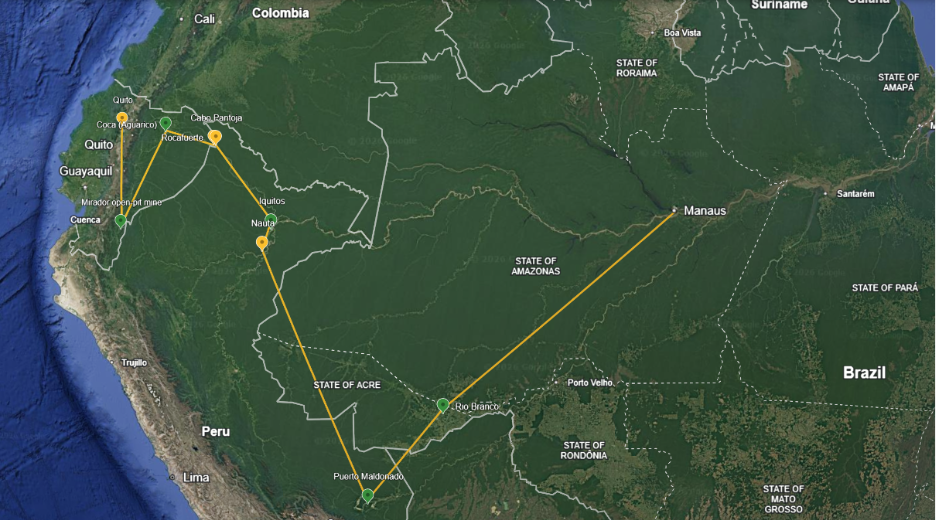
The journey began in Quito, the capital of Ecuador and a political and legal hub for struggles over the Amazon’s future, before moving south to Mirador – arguably the most emblematic open-pit mining project in the Pan-Amazon – and then north and east into the oil‑laden landscapes surrounding Yasuní National Park, one of the most biodiverse regions on Earth and simultaneously the biggest oil reserve in the country. Navigating south down the Napo River, we headed to the Peruvian capital of the Amazon: Iquitos, a city reachable only by water or air, and then continued into Madre de Dios, the Amazonian epicenter of illegal gold mining. A long overland journey northward took us into Brazil’s state of Acre, where we saw the forest suddenly disappear in front of our very eyes and extensive cattle ranching emerge in its stead. Our final stop was Manaus, a 2.28 million metropolis that rose to prominence with the rubber boom in the 19th century and stands as a symbol of the waxing and waning of extractivist fortunes in the Amazon.
Throughout this series, our goal is to integrate conceptual inquiry with lived experience and storytelling, to convey not only what we learned, but how we learned it: through conversations, landscapes, immersion, part-taking with locals, looking behind the scenes, and getting if only a glimpse of the entangled human and more‑than‑human communities that animate the Amazon. We hope these stories offer readers a textured sense of the territory’s crises and possibilities, the role of the church and of lived faith therein, and spark reflection on the forms of collaboration, responsibility, and imagination needed to co‑create a future‑proof world.
Welcome to the journey.
Acknowledgement: This work was supported by the Canada Research Chairs Program (Award ID: CRC-2020-00006), the Wubs Family Foundation, the German Catholic Academic Exchange Service (KAAD) in partnership with Bischöfliche Aktion Adveniat e. V., and the Elsa Neumann Foundation.