
Most of the climate solutions in the news headlines today make subtle adjustments to our current neoliberal systems via technological advancements, policy incentives, and market-based mechanisms so that we can go on living pretty much as we always have- at least in the West. These types of climate solutions (particularly decoupling proposals) serve as beacons of climate hope in our culture, but have proven insufficient to address the climate crisis and are truthfully dangerous, as they give us a false sense of security. Hope is essential for meaningful climate action, but if a hopeful trend doesn’t (a) account for consumption; (b) include improvements in other planetary boundaries besides CO₂, and; (c) demonstrate prioritization of demand-side reduction – the hope it brings us goes to support the status quo. In the fight for meaningful climate solutions that disrupt “business-as-usual” (BAU) approaches, the decisive battleground is narrative, which means that where we put our hope is key. This piece is not intended to suggest that we don’t need hope, or that there is no hope, but to encourage us to engage critically with what types of climate solutions we put our hope in.
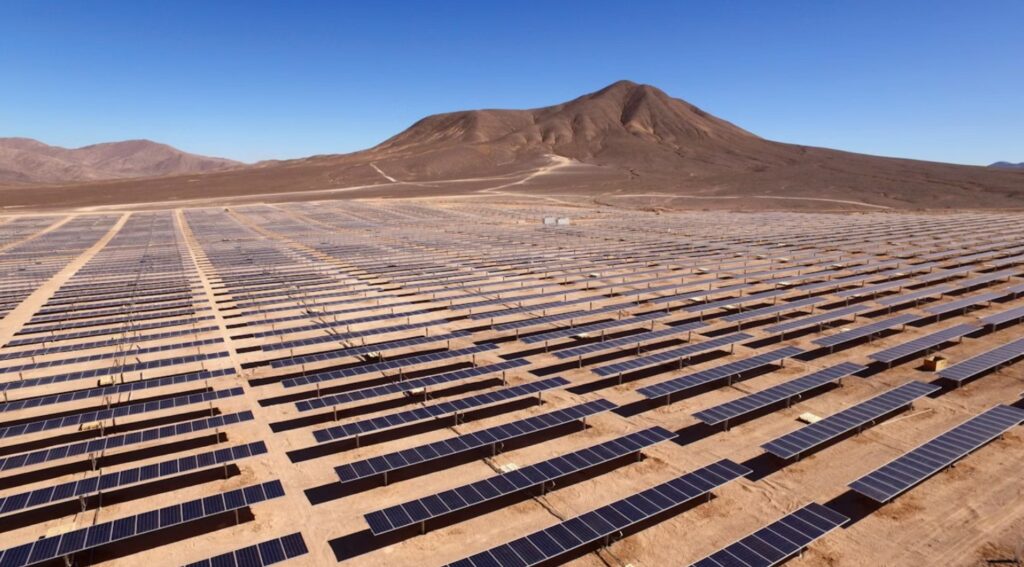
Photo of a solar farm in the Antofagasta region of Chile (now one of the largest hubs for solar power and energy storage in Latin America) by Antonio Garcia on Unsplash
Hope has become central in climate discourse and research. Scholars and practitioners argue that hope is essential to counter paralysis, maintain engagement, and sustain long-term action. Without hope, we lose the vision that our world can be better, and may slip into fatalism and cynicism, with disastrous results (read the piece by our partner Alex Pazaitis for more about this). However, we very rarely discuss the flip side of the issue; how our need for hope can turn it into a performative requirement – a demand to read climate trends optimistically even when the Earth system remains outside the safe operating space.
Building up to Earth Day, news headlines were filled with stories of climate hope, promoting successes from 2025 and promising possibilities for 2026. Indeed, there have been a few notable climate “wins” in the past few years. For example, there is evidence to show that clean power additions and falling emissions intensity in electricity are real and growing trends. In addition, recent analyses using Global Carbon Budget data show widening country‑level CO₂ decoupling – that is: there is some evidence of countries growing their GDP while territorial emissions fall, even when adjusted for consumption (check out studies by The ECIU, Our World in Data, and Hubacek et al. for more).
Unfortunately, while these trends are true (in that they have been conclusively identified and measured) they are partial, which makes them misleading. In the big picture, global earth‑system overshoot remains unchanged: six of nine planetary boundaries are transgressed, which means the safe operating space continues to shrink, and trends largely point in the wrong direction. Not only have larger studies identified that there is currently no evidence of decoupling at the global scale, but there are several reasons why this is unlikely to change in the future. For one, decoupling is often temporary (think for example how global emissions fell during the early days of the COVID 19 pandemic and rebounded quickly once lockdown restrictions were lifted) and reducing CO₂ emissions without sacrificing GDP growth long-term often comes at the cost of other socio-ecological priorities (i.e., land use change, biodiversity loss, human health). An excellent example of this is how decarbonization efforts that rely heavily on carbon offsetting and credits (like the UN REDD+ programs) can open the door to corruption and shift the burden onto vulnerable communities.
How we talk about climate change and its solutions (climate discourse) is not a neutral exchange of facts, it is a contest of performativity: what gets counted and celebrated does political work. Hope is a tool that can be used to improve our cultural perception of a specific climate solution, whether or not it is addressing the problem at the scale, speed, or strength necessary. Thus, to critique these climate solutions is not to admit defeat in the climate crisis, but to call out the danger of putting our hope in solutions that uphold the status quo and will fail serve us and the planet long-term.
Insisting on the actual political effects of a narrative does not deny the partial truths it may contain; but rather situates them. In some cases, positive signals of climate progress can be empirically meaningful and politically useful for mobilizing coalitions and avoiding fatalism. But when such signals are narrativized as proof that the current growth‑centric model is self‑correcting, they become a dangerous distraction, reducing our appetite for structural change and locking in BAU approaches. This reinforcement is not only plausible; it’s the predictable outcome when reported hopeful trends are not paired with hard constraints and accountability.
Partial truths are especially insidious in heavily politicized contexts because they authorize delay. A headline like ‘decoupling is now the norm’ can be read as permission to stay the course; a trajectory that has not only led us to transgress six of the nine planetary boundaries, but also conflicts with justice and integrity concerns.
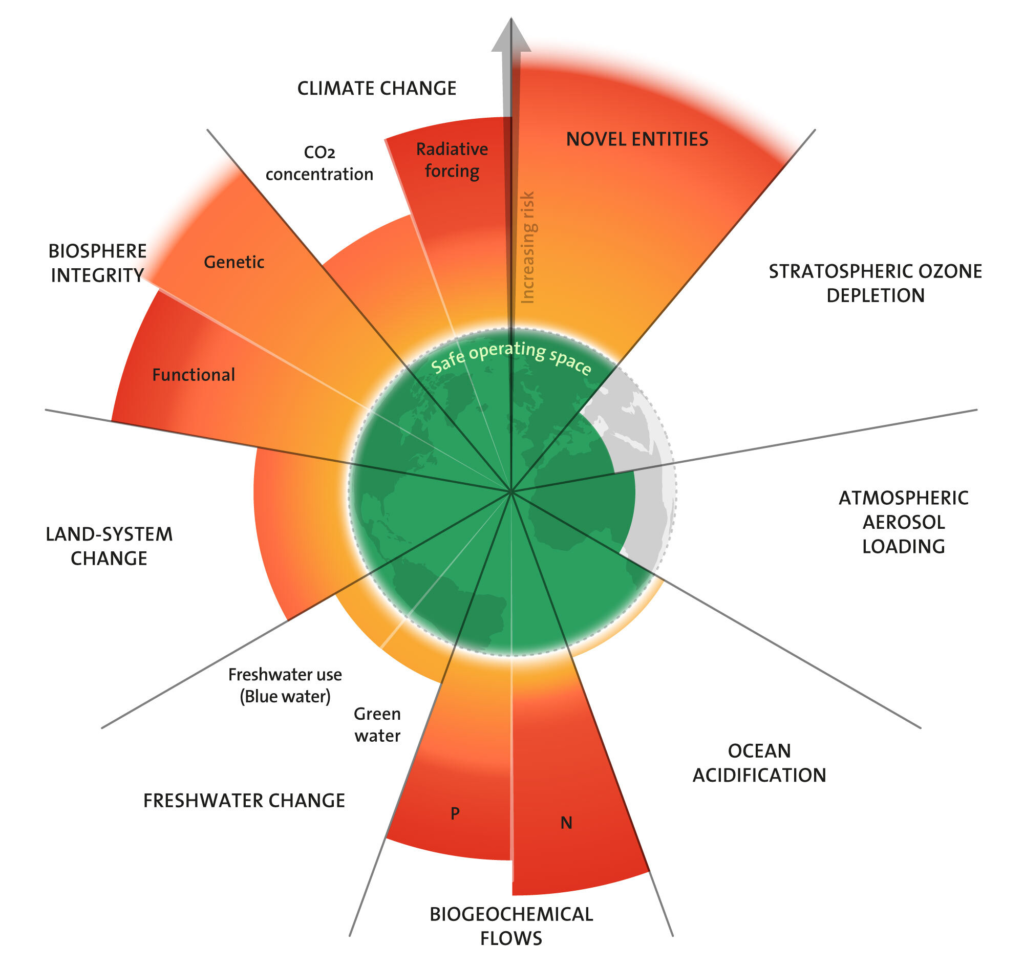
Illustration of the Planetary Boundaries. Image credit: Azote for Stockholm Resilience Centre, based on analysis Sakschewski and Caesar et al. 2025, published under CC BY-NC-ND 3.0
(If you are interested in learning more about the Planetary Boundaries and how they relate to one another, be sure to check out the interactive Planetary Boundaries tool created by the King’s Centre for Visualization in Science (KCVS)).
An important question thus emerges: how can we keep hope alive while being realistic about the radical changes we need to make to bring our societies back within ecological limits? We would argue that the goal isn’t to find a middle ground. To succeed, we must reject BAU approaches and understand socio-ecological sustainability holistically, as more than just cutting carbon. Concretely, resisting the comfortable middle means:
(1) reporting and governing against both territorial and consumption‑based CO₂, publishing divergences annually (Our World in Data; Hubacek et al.);
(2) adopting multi‑boundary dashboards encompassing all civilizational-level risk factors (land use change, biodiversity, freshwater, novel artificial chemicals, etc.) so that success cannot be claimed via problem‑shifting (Richardson et al.; SRC);
(3) fixing trade aggregation with embedded‑emissions standards, border adjustments, supply‑chain disclosure (IEA; Ember);
(4) enforcing an abatement‑first hierarchy for any offsets, with high‑integrity safeguards and transparent accounting (Transparency International; U4/CMI); and
(5) binding investment to sufficiency, making demonstrable absolute reductions in energy/material demand (e.g., repair/circularity, compact urban form, modal shift in transportation) a condition for public support and “green labeling”.
From the decoupling optimists, we keep the motivational value of real, measurable progress and the practical steps every transition needs, such as cleaning up power grids, electrifying transport, boosting efficiency, and upgrading industrial processes. But importantly, we add to these elements the non‑negotiable constraints and fairness principles (such as demand‑side sufficiency, absolute reductions in material and energy throughput, and redistribution) that are required for a just transition. Taking this route would ensure climate solutions that we can truly put our hope in, grounded in evidence of decoupling of the energy and CO₂ required to meet human needs and the promise of Degrowth (check out Jason Hickel’s “Less is More” and Giorgos Kallis’ “Degrowth”).
In conclusion, we don’t just need hope, we need disciplined hope. Our times require a meaningful kind of hope that refuses despair while confronting limits, in contrast to the corrosive kind we have discussed so far that justifies delay – call it hopium. To make hope do the right political work, we must change what we measure, how we allocate responsibility, and which truths we foreground. The real battleground is the story we tell, because the story sets the rules for climate action and governance. If our stories imply that growth‑centric systems are self‑correcting, they will reinforce those systems. But if our hopeful stories bind progress to structural constraints and justice, they will perform the change we need.
References (selected)
• International Energy Agency (2025), Global Energy Review; Breakthrough Agenda Report (Power).
• Ember (2025), Global Electricity Review.
• Richardson et al. (2023), ‘Earth beyond six of nine planetary boundaries’.
• European Environmental Bureau (2019), ‘Decoupling Debunked’.
• Hickel (2020), ‘Less is More’.
• Steinberger & Roberts (2010), ‘From constraint to sufficiency’.
•• Transparency International (2018), ‘Independent REDD+ governance monitoring’.
This piece was written by Dr. Adrian Beling (director) and Julia Gesshe (coordinator) of STAR Hub. Look out for the next installment of the Reflections on Hope series contributed by our partner Alex Pazaitis.