
The Life After Growth summer school, co-organized by the Tallin University of Technology (TalTech) and the P2P Lab in Greece in September of 2025, brought together students, researchers, activists, and practitioners from all over the world to explore opportunities for utopia in our crisis-ridden world through real-world commons-based initiatives (such as the Tzoumakers open lab). What I had not anticipated was the consensual view that emerged from the diverse group of participants around something that I have also observed while teaching at TalTech: green growth style techno-optimism is dead, and something more dangerous is beginning to take its place. In their book coming out in September 2026, Naomi Klein and Astra Taylor give it a name: End Times Fascism.
The fall of green growth techno-optimism
Western societies have long romanticized technology as the silver bullet for solving our problems and generally making our lives better. These ideas are so foundational to our culture that they are baked into our art as well (check out the retro futurist illustrations of Arthur Radebaugh to see how much better off we would be with flying cars and weather machines). Techno-optimism can be defined as the belief that technological advancement will always make our societies better, increasing our quality of life, solving our problems, and growing our economies. Green growth is a discourse that applies techno-optimism to the ecological crisis, promising us that new technologies will make it possible for us to grow economically (our politicians’ evergreen obsession) while also protecting the environment (necessary for our survival).

Photo by Jesper Giortz-Behrens on Unsplash
The P2P Lab crew have been debunking techno-optimism and other growth-based myths about technology for some years now, and our task used to be to explain why these “solutions” would not be effective to address ecological collapse. However, over the past few years, we have noticed in our university teaching that most students already come in with a widespread cynical view of technology, for example, seeing it as a vehicle for the rich to become richer, without solving any real problems. Some struggle to acknowledge any merits of the tech world at all.
On one hand, this would normally be good news, as we don’t need to fight the typical green growth BS anymore, before being able to make a case for real alternatives (e.g. degrowth). But what I fear is that the death of green growth may have opened the floodgates to something worse. In a nutshell: while green growth was a false hope, its presence in our public consciousness ensured that there was always a beacon of hope for solving the ecological crisis, however unrealistic, which encouraged us to work together. What we are now seeing is that the decline in techno-optimism has not been replaced with a different type of hope, and in this vacuum of cynicism and fatalism, far-right visions of techno-dystopia are starting to take hold. The “rant” that follows is an attempt to reflect on what we are up against and how we may see ourselves in this new and terrifying predicament.
The rise of cynicism, techno-dystopia, and end times fascism
“[T]he most powerful people in the world are preparing for the end of the world, an end they themselves are frenetically accelerating” – Naomi Klein & Astra Taylor, The rise of end times fascism
What I have observed in my teaching reflects a broader discursive shift in the so-called “West”, bolstered by the global rise of the far right. Cynicism and fatalism are at the heart of this emerging discourse, breading an ‘eat or be eaten’ mentality amid growing concerns about the “end of the world”. Political elites, billionaires, and religious radicals are energetically pushing the narrative that the earth is doomed to burn (ecologically and politically), claiming that we must take extreme actions (including but not limited to increasing militarization, hoarding resources, and dehumanizing marginalized peoples) to protect ourselves against impending threats. See for instance Alex Karp’s – who infamously studied philosophy under Habermas – sadly influential book.
The way in which this techno-dystopia is being spread is also quite insidious. Proponents strategically combine apocalyptic messages with co-opted anti-systemic language (the kind used by labour unions, feminists, and environmentalists to critique the capitalist, neoliberal world system) into a deadly cocktail. These disruptive discourses are easily taken up at several levels of society – in this case, uniting the ultra-rich and egomaniac techno-bros with doomsday preppers and religious fundamentalists in active pursuit of their version of the Rapture. There is evidence to suggest that this discourse is growing fast, with a recent study finding that end-of-world beliefs are becoming increasingly common among North Americans.

Fire above Carson City, Nevada, July 2, 2021. Photo by Tim Mossholder on Unsplash
The very nature of this end times fascism unfortunately gives it a strategic advantage over any sort of politics of hope that we may represent, for two reasons. First, as Klein and Taylor perfectly observe: the failure of the West to meaningfully act is accelerating ecological collapse, creating a perfect self-fulfilling prophecy. Second, it is no surprise that this type of ideology becomes hegemonic in the “West”, as the “West” declines from world hegemony itself. End times fascism is the natural response of elites who know that their world would come to an end if we were to effectively address the socio-ecological crisis. Thus, instead of using their billions to invest in saving the world, they retreat into techno-dystopia and choose to spend their money on building bigger and better bunkers.
In other words, the “West” is pretty much like a spoiled child-bully who, once they start to lose a football game, kicks the ball away so that no one else gets to play at all. In truth, the earth doesn’t have to burn, but far right elites are working hard to convince us (1) that it will and (2) that there is nothing we can do about it.
Where can we find hope?
All of this is not a call for fatalism or further cynicism – quite the contrary, actually. Far right elites may have the tech necessary to pull off their authoritarian dystopia – powered by mass-surveillance, de-humanization, and violence – and the influence to spread the kind of hopeless, disenfranchised cynicism that makes the rhetoric of end times fascism appealing to the masses. But we have something they don’t: a genuine determination to double down on hope, emphasizing those parts of our story that break that wall of cynicism: from embracing vulnerability to reinstating forms of collective organizing that nurture human togetherness and fend off fear. And by highlighting real alternatives that bear promise that we can re-appropriate technology and the economy for the common good.
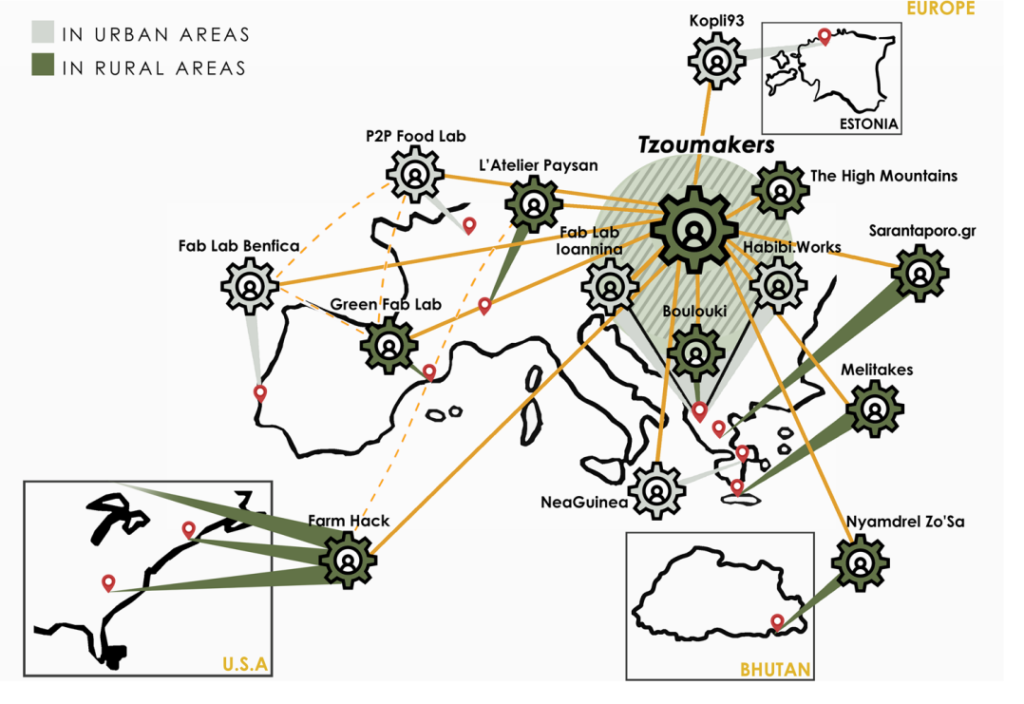
The growing network of Tzoumakers. Small and local-oriented but globally connected initiatives create a cosmolocal ecosystem of value creation. Taken from “Beyond global versus local: illuminating a cosmolocal framework for convivial technology development” (Kostakis et al., 2023). Licensed under CC BY 4.0. No changes were made.
This means that as proponents of end times fascism co-opt the means to look critically on the world as something not worth being saved, we come in with the means that describe and create another world that is worth it. In a twisted inversion of history, we may well become the new “techno-optimists”, this time advocating for technology as a worlds-making force that seeks to enable autonomy instead of surveillance and control; that enhances human organizing rather than replacing it; and that values life for what it is, not for the data it generates. I feel we are reaching a position where the “tech won’t save us” narrative needs to become something like “tech can be a tool of resilience, autonomy, and protest”.
After decades of environmentalists being framed as “the prophets of doom”, it could be a refreshing change to actually be the “optimists” for once (and in a more wholesome, realistic way than the half-assed, sterile, and unclimactic tales of green growth). After the demise of a story about technology that would magically solve our problems, we can speak of a technology that is actually embracing the magic of creation and the re-enchantment of the world.

Close-up of an industrial knitting machine used for textile manufacture. Photo by towel.studio on Unsplash
What many people aren’t aware of is that there are alternatives to the false utopia of green growth and the techno-dystopia of the far right. Examples include the technology commons and cosmolocalism, design global manufacture local (DGML), and the development of convivial technologies. In these types of systems, technology is placed in the hands of communities, enabling the development of local systems of production that increase resilience and plant the seeds of alternative local economies. At the same time, local communities do not need to reinvent the wheel, as the internet offers global interconnection for access to common and freely accessible repositories of design, knowledge, and code to which everyone can contribute and from which all benefit.
The amazing thing is, none of this stuff is new. We at the P2P Lab and beyond have been working on these ideas for a long time, and are confident that they can work in almost every place they reach. We are also exploring new collaborations to create new windows of opportunity, such as the BIRTHING the P2P Society Program in partnership with the STAR Hub. As the Majority World gets increasingly fed up with the techno-fascists defining what version of the future is viable, we will certainly find ways to get these ideas to more places and more people, both locally and globally.
…
Alex Pazaitis is a researcher and lecturer at the Ragnar Nurkse Department of Innovation and Governance, Tallinn University of Technology (TalTech), and a core member of P2P Lab. He is an active member of STAR Hub who has significant experience with projects involving the digital commons, innovation policy, degrowth, and more. This article was adapted by Julia Gesshe from a short piece Alex shared with us.