
Amazonia: The dwelling place of life – and death
Traveling through northern Ecuador’s oil-rich landscapes feels like stepping into a paradox. The rainforest is breathtaking – dense green canopies and rivers winding like threads in a tapestry as far as the eye can reach – but beneath this beauty lies a history of extraction and erasure.
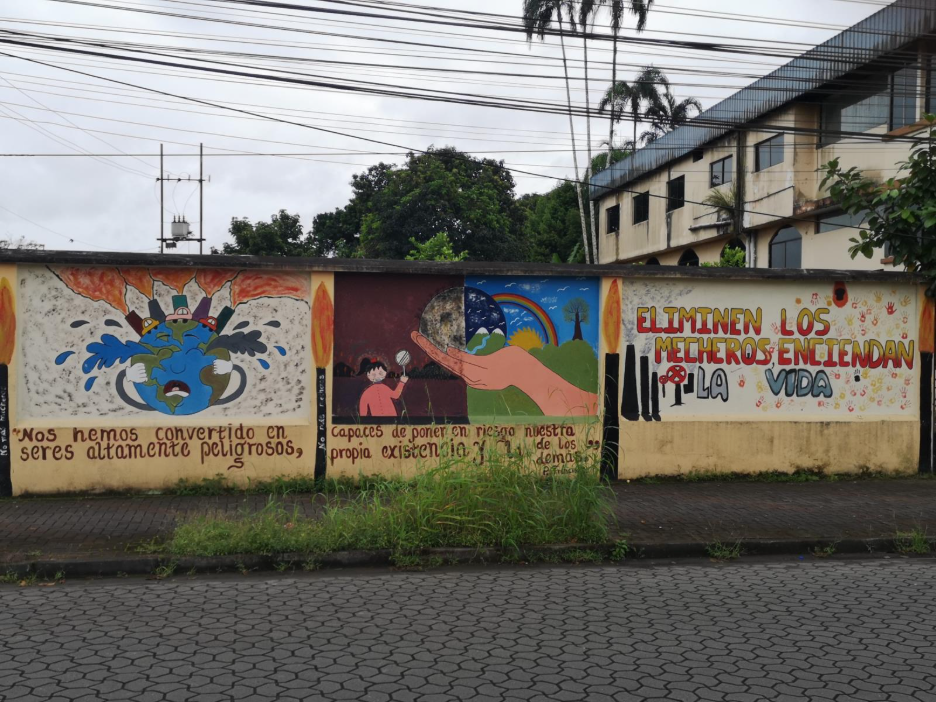
Photo: Murals in the outer walls of the Aguarico Vicariate premises. Transl. (left to right): “We have become highly dangerous beings capable of endangering our own existence and that of others”; “Turn off the flares; turn life back on” (campaign slogan against gas flares) (Photo: A. Beling)
Ecuador’s oil boom began in the late 1960s when Texaco (now Chevron) drilled its first wells in the northern Amazon. By the 1980s, oil accounted for more than half of the country’s export earnings. The state granted many concessions overlapping Indigenous territories or protected areas, often without consultation. The logic was simple: subsurface resources belong to the nation, not to the communities above them. This legal framework made displacement and ecological destruction a policy. Oil companies have, in many places, come to occupy the role of the state in the provision of basic services, from education to health care, but this has come at a high price: forests have been destroyed, along with the biodiversity and the livelihoods they sustained; gas flaring and recurring spills have contaminated the air and water sources; and governments and communities alike have become locked into dependence on oil revenues – for both taxation and employment.
In May of 2025, I travelled with two doctoral research affiliates from the FIAT project (“Faith Institutions Advancing Transformation”), Nils Mojem and Hector Pérez, to the city of Coca (formally named Puerto Francisco de Orellana, after the Spanish conqueror) arriving after a long overnight bus journey from the country’s capital, Quito. We were hosted at the Apostolic Vicariate of Aguarico, a Catholic mission territory that has become not only a hotspot for oil-related conflicts, but also for intercultural encounter, Indigenous defence, and environmental justice. The Vicariate outer walls tell the stories of resistance through dramatic murals. Inside the walls, a lavish tropical garden sings a song to life – a literally audible song by a chorus of birds and insects.
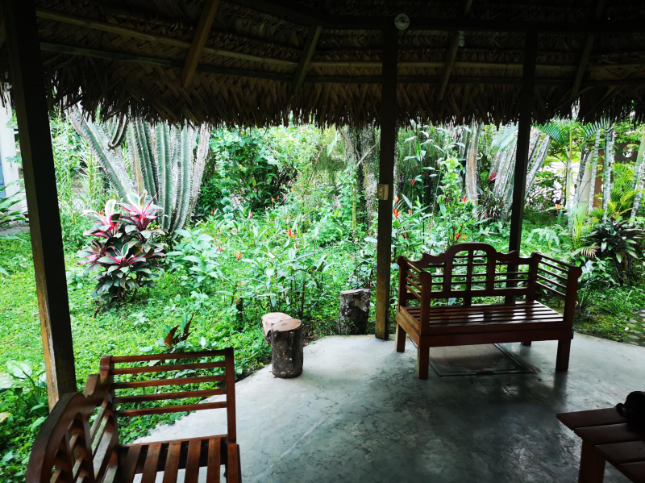
Photo: The FIAT project team’s usual meeting place in the gardens of Vicariate of Aguarico (Photo: A. Beling)
But death is also prevalent, or to be more precise, is thoroughly intertwined with life in this scene. An austere tombstone stands out from the exuberant vegetation, marking the final resting place of one of the Vicariates foremost figures of resistance: Jose Miguel Goldaraz – better known by his Indigenous name Achakaspi, which in Kichwa means “axe wood” or “strong timber” – a Spanish Capuchin monk who spent over 50 years living along the Napo River (Coca, Pompeya, Nuevo Rocafuerte), fully immersing himself in Indigenous life. His name reflects his courageous fight for Indigenous rights, territorial integrity, and cultural preservation in the face of extractivism and state neglect. Achakaspi passed away in April of 2025, and his funeral included Kichwa, Shuar, and Waorani rituals, honoring him as a wise elder and defender of the Amazon.
Indeed, Achakaspi is an important reference of spiritual leadership and resistance in Aguarico, but he is not in fact the main one. That place is reserved in the local culture for the two missionaries who gave their lives in 1987 trying to protect the Tagaeri – an Indigenous group living in voluntary isolation: the Vicariate’s first bishop, Alejandro Labaka and Capuchin Sister Inés Arango.
Their story is gripping. During our visit to Coca, we heard it told by at least a dozen people – priests, teachers, taxi drivers, even an oil subcontractor. They all spoke of Alejandro’s and Inés’ courage and heroism. But what was more striking to me is what they all left out of the narrative: an unquestioned naturalization of violence in the Amazonian territory.
The story of Alejandro and Inés
Alejandro Labaka was born in Beizama, Spain in 1920, joined the Capuchin order in 1937, and was ordained in 1945. His missionary path took him first to China, where he was expelled during the Maoist regime, and then to Ecuador, where he spent over three decades ministering to local Indigenous communities. In 1984, he became the first bishop of Aguarico.
Sister Inés Arango Velásquez was born in Medellín, Colombia in 1937, and entered the Capuchin Tertiary Sisters of the Holy Family at age 17. After two decades as a teacher, she joined the mission in Ecuador in 1977.
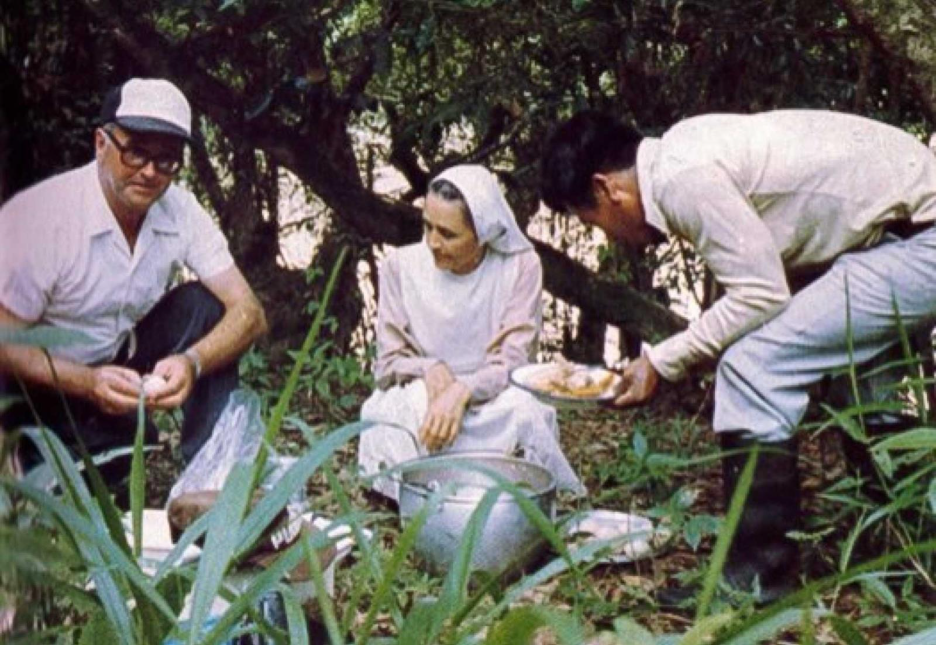
Photo: Spanish Bishop Alejandro Labaka Ugarte of the Apostolic Vicariate of Aguarico, Ecuador, left, and Colombian Sister Inés Arango Velásquez, a member of the Capuchin Tertiary Sisters of the Holy Family, are pictured in an undated photo in the Ecuadorian Amazon. (Courtesy of General Curia of the Capuchin Friars Minor)
By the mid-1980s, oil companies were pushing deeper into Yasuni National Park, home to the Tagaeri and Taromenane peoples. Representatives from an oil company made an appointment to talk with the local bishop, to let him know that they were going to enter Tagaeri territory. Alejandro feared violent clashes and the eventual extermination of the group. On July 21, 1987, against every advice, Alejandro and Inés flew into Tagaeri territory hoping to warn them. Their last words before boarding the helicopter were: “if we don’t go, they are going to kill them all”. Inés left a farewell letter behind expressing her total surrender to God’s will, her missionary commitment to the most vulnerable, and a spirit of peace and reconciliation, even in the face of danger. The next day, it was Achakaspi who flew in and recovered their bodies, pierced by spears – Alejandro with fifteen wounds, Inés with three.
Jesus Esteban Sádaba, emeritus bishop of Aguarico and immediate successor of Alejandro Labaka, informed us that “what the oil representatives had conveniently omitted in their meeting with Alejandro is that they had already sent a raid to the territory a week earlier, resulting in the killing of the Tagaeri leader”. So, when Alejandro and Inés arrived, they were mistaken for representatives of the oil company that had sent in the murderous party. One of the spears recovered from Alejandro’s body – an impressive, three and a half meters long craft – is now exhibited behind the altar of the Capuchin chapel located in the premises of the Aguarico Vicariate.
National and international public outcry following the death of Alejandro and Ines – coupled with pressure from the Catholic Church, NGOs, and Indigenous organizations – resulted in the Ecuadorian government considering legal measures to protect isolated peoples. In 1999, Ecuador officially established the Tagaeri-Taromenane Intangible Zone (ZITT, by its Spanish acronym) within Yasuní National Park that prohibits extractive activities (oil, logging, mining) and aims to safeguard the territory of uncontacted groups within within the Zone. This legislation became a cornerstone of Ecuador’s constitutional recognition of Indigenous rights in 2008.
Martyrdom reloaded: The “Offering of Life”
Following their deaths, Alejandro and Inés were venerated as martyrs and saints by believers and non-believers alike far beyond northern Ecuador. Today, the church formally recognizes Alejandro and Inés’ sacrifice under the category of oblatio vitae (“offering of life”) – an aggiornamento (“update”) to the millennial institution of martyrdom in the Catholic Church introduced by Pope Francis in 2017. In May 2025, Pope Leo XIV initiated the beatification process, which marks the first step toward sainthood, according to Catholic tradition.
Unlike traditional martyrdom, which requires death in hatred of the faith, the oblatio vitae category honors those who freely give their lives out of love for others. This addition is far more than a technical tweak in canon law; it marks a profound reimagining of Christian witness for a cultural context where traditional martyrdom (death tied to explicit hatred of the faith) no longer captures the complexity of contemporary threats to life. Alejandro and Inés were not slain for preaching the Christian gospel; they died because they stood between extractive capital and vulnerable lives. Today, violence against life often comes not from religious hatred but from systemic forces – economic, ecological, political – that commodify existence and disregard human dignity.
In an era of ecological collapse and social fragmentation, the witness of Alejandro and Inés becomes paradigmatic: faith expressed as defense of life, not as triumph over enemies. In a culture suspicious of absolutes yet hungry for meaning, oblatio vitae functions as a bridge concept. It honors the depth of religious motivation while articulating values intelligible to a wider moral community. It signals that the Church is listening to history; martyrdom as confrontation has given way to martyrdom as accompaniment, making Christian witness speak credibly in a world where the greatest threats are not the gatekeepers of orthodoxy but systems that commodify life.
By introducing oblatio vitae, the Church strategically adapts its theology of sanctity to a globalized, pluralistic context. It shifts the focus from confessional identity to relational ethics—what the late Pope Francis called “the primacy of love.” In doing so, it bridges dialogue with other traditions that prize altruism, justice, and care for creation. This language resonates with liberation theology and Protestant social ethics, as well as secular philosophies of care.
Conclusion: What does it mean to honour the martyrs and defenders of the Amazon today?
The key question raised here, however, remains unanswered: How is it possible that Alejandro and Ines were cornered between sacrificing their own lives or sacrificing those of others? How could extractivist interests simply get away with violating a biosphere reserve to “make way”, even if that meant wiping out an entire people? Where was the state to guarantee the safety of the Tagaeri? And how could society at large simply ignore – or worse: tolerate – this kind of behaviour?
This silence reveals a structural blind spot: the naturalization of extractivism (and the violence that comes with it) as inevitable – a “given” beyond moral scrutiny, a “natural” force rather than a political choice.
In spite of its legal status as a no-extraction zone since 1999 and to this day, violations of the Tagaeri Taromenane Intangible Zone (ZITT) in Yasuní National Park have been frequent and systematic. Oil blocks surround the zone on all sides, and incursions have occurred repeatedly due to seismic surveys, drilling, and infrastructure expansion. Contradicting its own ruling, the state itself has opened new concessions within protected territories. Around 16% of Ecuador’s land surface has now been allocated to oil blocks, and nearly half of Indigenous territories overlap with extraction zones. The Inter-American Court of Human Rights (IACHR) ruled in March 2025 that Ecuador violated the rights of the Tagaeri and Taromenane by failing to prevent illegal incursions and allowing extractive operations near or inside the zone, resulting in further killing of members of the Tagaeri and Taromenane in 2003, 2006, and a full-fledged massacre in 2013. The court decision comes after voters in a 2023 national referendum opted to keep the 846 million barrels of crude permanently in the ground underneath part of Yasuní National Park. The country’s Constitutional Court gave President Daniel Noboa’s administration one year to decommission drilling – closing 247 wells, dismantling infrastructure, and remediating and restoring the region. To date, only four wells have been closed, exacerbating the existential threat to the Tagaeri-Taromenane, which continue to suffer incursions not only by oil workers, but also by loggers and colonists.
To honor Alejandro and Inés is not only to tell their story and praise their heroism, but to confront the system that made their deaths possible – maybe inevitable. That means challenging the assumption most people take for granted: That extractive interests can do what they want to whomever they want, without facing any consequences. Until we do, martyrdom risks becoming a romanticized anecdote rather than a prophetic call for justice. What we honour in martyrs is not romantic heroism; it is radical solidarity with the vulnerable of this world. The sustainability transition begins where the systems of structural violence against humans and non-human nature are named and actively confronted. There is no sustainability without justice.
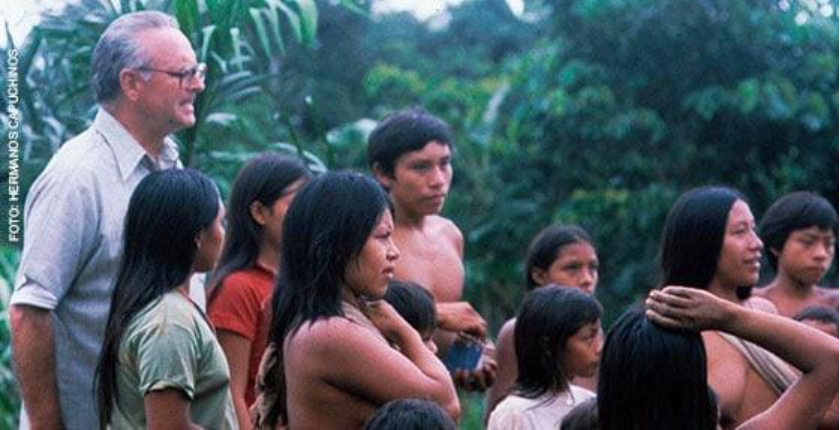
Photo: Alejandro Labaka with an Indigenous community (undated photo courtesy of the General Curia of the Capuchin Friars Minor)
Author Bio: Dr. Adrian Beling is the Director of STAR Hub and Canada Research Chair in Transition to Sustainability at The King’s University. This piece is a reflection on his experiences conducting field work in the Amazon as part of the Faith Institutions Advancing Transformation (FIAT) project with research affiliates Nils Mojem and Hector Pérez.
Suggested Readings and videos:
- Maiorem hac dilectionem – Apostolic Letter by Pope Francis on the “offering of life.”
- Aguarico Vicariate Blog dedicated to Alejandro and Ines: https://web.alejandroeines.org/ (Spanish)
- Documentary about Labaka and Arango by the Pan-amazonian Ecclesial Network (REPAM) (Spanish): https://www.youtube.com/watch?v=EBiKUgPHAkQ&pp=ygUWYWxlamFuZHJvIGxhYmFrYSByZXBhbQ%3D%3D
- Drilling Toward Disaster: Amazon Crude and Ecuador’s Oil Gamble – Amazon Watch: https://future.amazonwatch.org/news/2025/0617-drilling-toward-disaster
- In the Ecuadorian Amazon, Oil Threatens Decades of Indigenous-led Conservation – InfoAmazonia: https://infoamazonia.org/en/2023/12/15/in-the-ecuadorian-amazon-oil-threatens-decades-of-indigenous-led-conservation/